


By professionals for professionals
Since just over a year, a robot-assisted deburring system by WEBER has been in operation at Benning Elektrotechnik und Elektronik in Bocholt.

By professionals for professionals
Since just over a year, a robot-assisted deburring system by Weber has been in operation at Benning Elektrotechnik und Elektronik in Bocholt. This purchase has paid off in more ways than one: the new system significantly reduces the workload for the operator, while at the same time increasing productivity.
Michael Puhe, responsible for work preparation at Benning Elektrotechnik und Elektronik in Bocholt, is more than satisfied: "Deburring is now much easier and more effective for us. The employees who are responsible for this, and all of us, would not want to be without the new machine anymore. After all, it has allowed us to properly address our issue, streamline our operations significantly and create more capacity."
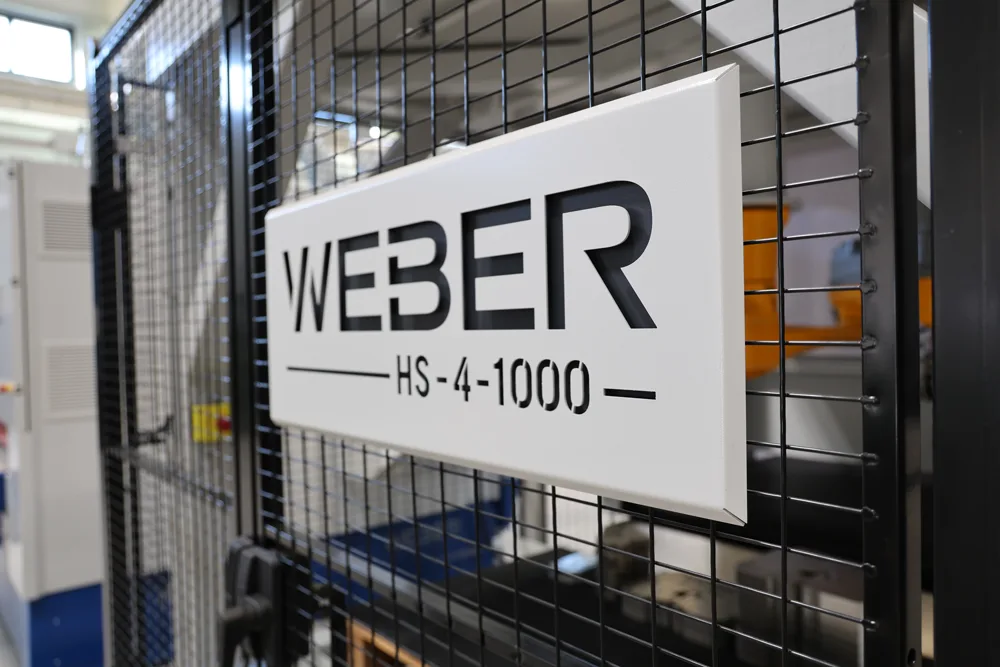
But let's start at the beginning. Before the new installation, consisting of a WEBER HS-4-1000, robotic cell, a pallet station and the WEBER NLC-1100R2, metal wet sanding machine, was installed, the sanding and deburring process at Benning was relatively complex and not all that automated.
The workpieces used to arrive at the conveyor on a pallet, which guided them to the automatic deburring machine and used to be loaded manually. This belt was about two metres long, so that enough work pieces could be processed in a single operation. The parts to be processed passed through the deburring machine, which was approximately four metres long, and then fell onto a pallet at the end of the outfeed conveyor, from where they were sent for further processing, such as bolting or bending.
Disorderly deposition
In addition, there was always the risk that the deburred workpieces would be scratched or jammed when they fell onto the pallet. Michael Puhe: "The employee who worked here was constantly running around: Having manually loaded the belt in front of the machine, he had to walk several metres to the end of the outfeed belt to make sure that the workpieces were deposited in an orderly manner. This was rather stressful, in addition to taking up a lot of actually unproductive time, and being far from optimal."
Since the whole process was taking too long, he says, they had to keep running overtime on the deburring machine in order to keep up with the company's productivity environment.
Things could not go on like this. "We wanted to optimally automate the entire process, and make it more efficient. Above all, orderly stacking of the parts was crucial to us. Moreover, the new solution needed to fit into our networking and digitisation strategy, in other words, be able to communicate with the other machines into whose processes it was to be integrated."
A clear requirements profile
And so it happened that Bernd Teloeken, head of work preparation at Benning, turned to the experts at WEBER with a clear, detailed requirements profile. This profile included not only Benning's wishes in terms of automation and robotics, but also the installation's ability to generate and process data.
Michael Puhe sums up the result as follows: "Weber has delivered what we requested."
Today, only the infeed belt is still loaded manually with the metal parts to be deburred. In parallel, the operator can now load and unload the adjacent machine, a drum sander. "Before, there was never any time for that."
The WEBER NLC-1100R2 sanding machine deburrs the work pieces, following which the robot in the HS-4-1000 robotic cell picks up the processed parts and neatly stacks them. To this end, the system automatically determines the optimum gripping point of each part, using optical surface recognition combined with appropriate software.
Automated stacking not only has the advantage that the work pieces are placed on the pallet in an orderly manner, but also the rather welcome side effect of the space being better utilised, as a result of which more pieces can be fitted on the pallet.
What's more, the WEBER pallet station also supports the automation process: Once a pallet is fully loaded, it is automatically moved out and a new, unloaded pallet is then moved in. Needless to say, WEBER's experts have completely integrated their system into Benning's ERP system.
Future-proof investment
It is hardly surprising that Michael Puhe arrives at a positive conclusion: "Our employee doesn't need to keep running to and fro anymore. Now he can get more done, operate two machines in parallel and thus also bear more responsibility. Even better, the WEBER system can communicate with the other machines and thus supports our digitisation. All in all, this purchase has clearly proven to be a future-proof investment."
Since stagnation would mean decline, Michael Puhe and his boss Bernd Teloeken have already come up with the next ideas to further optimise their processes. "At the moment, the pallet yard comes to a standstill as soon as two pallets are in. This downtime could definitely be shortened with an automated guided vehicle, or AGV, system."
Especially since the WEBER system would be able to kit out the AGV with the necessary information for the removal. Incidentally, the delivery of the pallets could also be automated in a similar manner, Michael Puhe says, taking the idea further. "I'm sure that if we want to make that happen, it won't be a problem for WEBER's IT people. They are clearly real professionals."