

The highest quality and maximum efficiency through automation

The highest quality and maximum efficiency through automation
PIETEC Feinwerktechnik is taking on global competition. A WEBER deburring machine with an automation system reduces effort and saves time.
Halfway between Kassel and Dortmund, at the Bad Wünnenberg-Haaren motorway junction, lies the headquarters of PIETEC Feinwerktechnik. As a specialist capable of meeting even the most demanding requirements in metalworking, the company enjoys an excellent reputation among its clients. For the clean deburring of its workpieces, PIETEC relies on a deburring machine from WEBER.
Christoph Piepenbrock is a busy man. No wonder, given that he runs, together with his father Reinhard, a company that is highly sought-after and successful in the industry: PIETEC Feinwerktechnik.
The contract manufacturer produces high-quality individual parts and assemblies according to its customers’ wishes and specifications. PIETEC products can be found in white goods, electrical systems and control cabinets, in special-purpose machinery, medical technology and the sanitary sector, to name just a few market segments.
Impressive range
“Our range has grown over decades in line with customer requirements and is now very extensive,” explains Christoph Piepenbrock. “This versatility means we are now independent of specific industries. Anyone who needs a cleanly finished metal component, whatever the application, is generally in the right place with us.”
The company was founded by Reinhard Piepenbrock in 1992 in Paderborn, a half-hour’s drive from the current headquarters. At that time, it was still operating from rented premises. And it seems he had the proverbial ‘luck of the hard-working’ right from the start: just four years after its foundation, PIETEC – by then with a workforce of 17 – moved into its own premises in Bad Wünnenberg-Haaren.
Today, the company has several production halls and, with around 130 employees, processes workpieces made of steel, stainless steel, aluminium and galvanised sheet metal. The machines at PIETEC are capable of processing components up to three metres in length and one and a half metres in width – usually from sheets between 0.5 and 1.5 millimetres thick. They are cut to size using a flatbed laser or a coordinate punching machine.
Clean deburring required
In both cases, it is necessary to deburr the workpieces. Not only to prevent injuries from the sometimes very sharp burrs, but also to prepare the surface for coating or to facilitate further processing. Not to mention that a cleanly deburred workpiece simply looks more appealing.
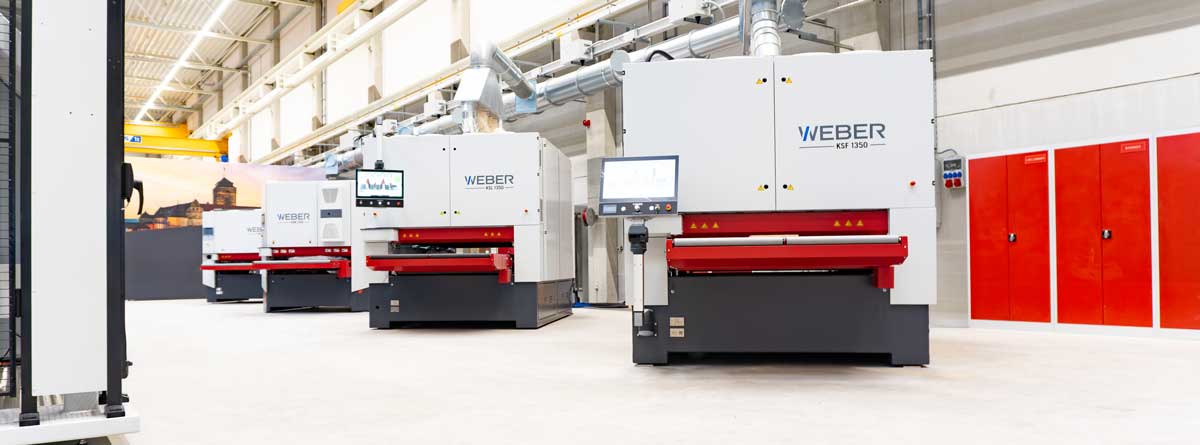
After PIETEC’s first deburring machine had been in service for two decades, the two managing directors decided in 2021 that it was time to consider purchasing a new machine. “We finally commissioned our new WEBER machine in April 2024; by then, its predecessor had well over 20 years under its belt,” recalls Christoph Piepenbrock.
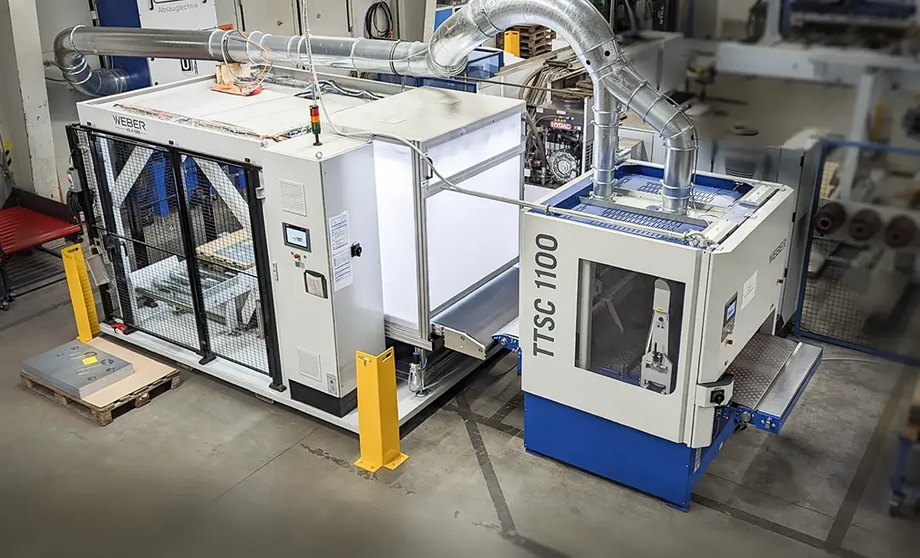
A key requirement for the new system was the move towards automation. “We searched long and hard and finally opted for WEBER, primarily because their machine can be combined with an autonomous unloading cell. A crucial factor for us was that WEBER offers this combination virtually as standard – so we were able to avoid lengthy adjustments from the outset.”
Robot cell provides massive relief
The robot-controlled removal of the deburred workpieces alone has since provided massive relief for the machine operators and accelerated the processing, as Christoph Piepenbrock explains. “Before, we either needed two staff members at the machine, or one had to constantly run back and forth between loading and unloading. As a result, the whole process now runs twice as fast as before automation with just one employee.” It is particularly helpful that the robot operates without the need for teaching: a 2D vision system scans the respective workpiece, captures its geometry and automatically calculates .