


WEBER sanding
WEBER LDK
4
sanding stations
up to 3200 mm
working width
Processing in multi-shift operation
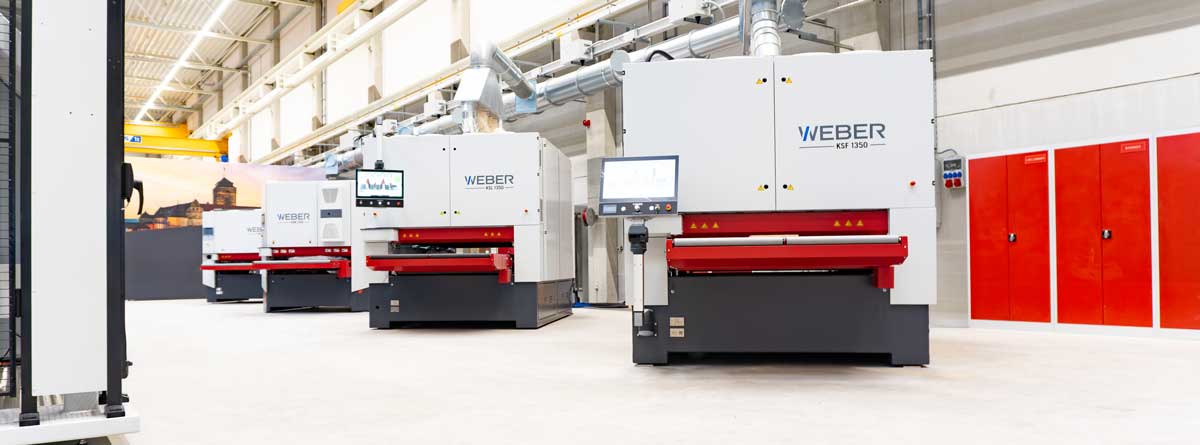
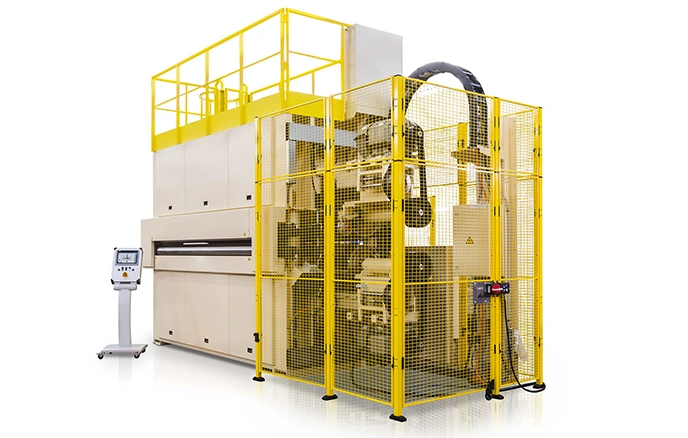
The WEBER LDK double-head automatic sanding machine is a high-performance sanding machine for the panel industry and was developed specifically for demanding multi-shift operation. As a custom-built machine, the LDK can be extensively tailored to the customer’s individual requirements and preferences.
The term “double-head” refers to the machining of parts using two calibrating rollers that act on the workpiece from above and below at the same position. This enables the LDK to machine both sides of the workpiece at a single station.
The robust machine design is consistently engineered for continuous operation and for integration into modern production lines. As a result, the WEBER LDK is ideally suited for industrial manufacturing processes with high capacity utilization and continuous material throughput.
With drive power of up to 160 kW per grinding belt and high feed speeds, the machine ensures maximum efficiency and productivity. The cutting speeds are also optimally tailored to the specific requirements of the panel industry and ensure consistently high-quality results.
The WEBER LDK thus stands for high performance, customizable flexibility, process reliability, and high cost-effectiveness in industrial multi-shift operation.
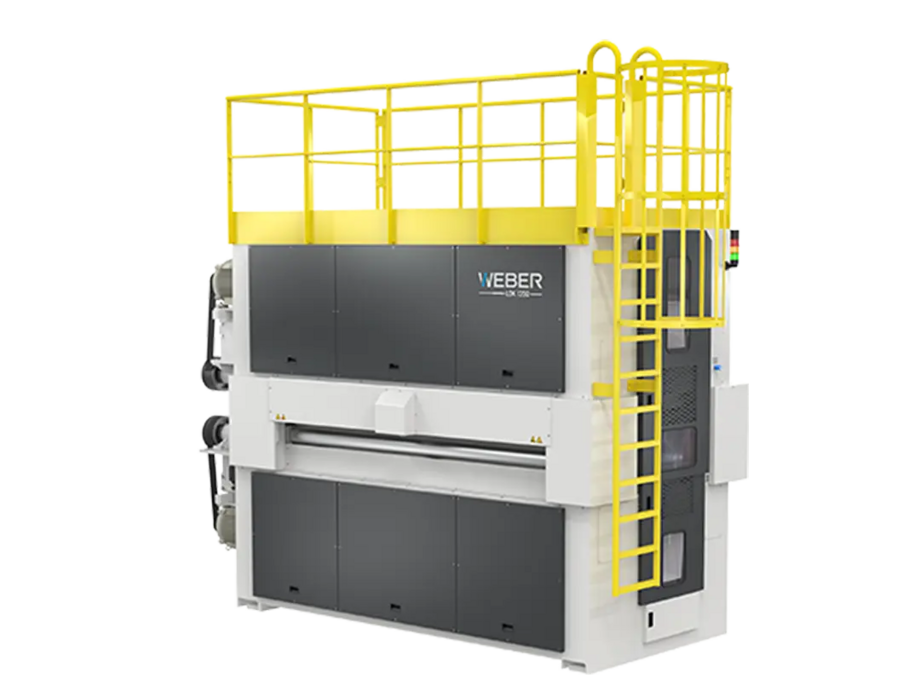
Technical specification
WEBER LDK
Special machine for the panel industry
- working widhts
- 2700, 3200 mm
- Calibration roller drive
- 160 kW
- Sanding belt length
- 3200 mm
- Operation
- "i-Touch" Controller, Multi Panel
- sanding stations
- up to 4 sanding stations
- Sanding units
- contact roller unit (D)
![[Translate to English:] WEBER Icon Furnierschliff](/fileadmin/user_upload/WEBER%20mediapool/WEBER%20sanding/Icons/Furnierschliff.webp)
![[Translate to English:] WEBER Icon Kanten verrunden](/fileadmin/user_upload/WEBER%20mediapool/WEBER%20sanding/Icons/Kanten_verrunden_Holz.webp)
![[Translate to English:] WEBER Icon Massivholz](/fileadmin/user_upload/WEBER%20mediapool/WEBER%20sanding/Icons/Massivholz.webp)
WEBER working stations
Available in steel or rubberized versions, our rollers are designed for durability and resistance to meet the requirements of a wide range of sanding processes. Thanks to our advanced technology, our contact rollers enable extremely precise calibration in the 0.01 mm range. This ensures that even the most demanding sanding jobs can be carried out with the highest accuracy. Our rollers can be used to achieve various effect sanding finishes, giving your wood projects a special and individual touch.
A polished surface free of oscillation marks is an outstanding quality feature. WEBER has found the solution for this with CBF technology. It works with a transverse pressure flap belt arranged within the wide belt station. The pressure flaps interrupt the engagement of the abrasive grains and thus avoid the undesirable oscillating sanding marks of the sanding belt. The result: The surface is smooth and even. The flap belt runs without control, maintains the full tolerance compensation of the link pressure beam, wears evenly and is inexpensive to replace.
Another advantage of CBF technology is that, in contrast to classic cross-sanding, one grit level can be skipped. This means that you can achieve particularly fine sanding results with our system without compromising on quality.
![[Translate to English:] WEBER CBF-Technologie](/fileadmin/_processed_/b/7/csm_CBF_Aggregat_2_98120d5ed2.png)
![[Translate to English:] CBF Technologie WEBER](/fileadmin/_processed_/4/5/csm_RDI_6188_867abe47f6.png)
Uniform sanding pressure on the edge and surface is a prerequisite for good sanding results. WEBER's solution: Freely movable pressure pieces, which are firmly connected to the sanding lamella, always automatically position themselves flat against the sanding belt; the required even pressure distribution on longitudinal and transverse edges is achieved automatically. Interfering lateral forces on the adjusting cylinders are avoided. The arrangement of the pressure pieces on the sanding lamella eliminates the need for any additional guides that are susceptible to soiling; the system is completely maintenance-free. In addition, certain areas can be processed with different sanding pressures. This is a major advantage when sanding between coats of paint, for example, where certain application methods cause paint material to build up on the edges.
![[Translate to English:] ISD Gliederdruckbalken](/fileadmin/_processed_/6/a/csm_ISD_Gliederbalken6_0b2fe2c4fb.png)
![[Translate to English:] ISD Gliederdruckbalken](/fileadmin/_processed_/c/b/csm_ISA_ISD_8174b5a8e2.png)
Cross sanding is a tradition at WEBER. Cross sanding means that in the first sanding step, the surface is sanded across the feed direction, followed by finishing sanding along the length. The crossing cutting movement offers advantages over multiple longitudinal sanding. The cross grain sanding belt works at a 90° angle to the fiber. This shears off coarse wood fibers. The subsequent wide belt is tasked with cutting off the turned-over fibers and smoothing the surface. Due to the crossing sanding direction, significantly fewer and shorter fibers remain on the surface.
Your advantages at a glance
WEBER has developed three separate series for processing sheet-like materials. As these sanding machines are subject to different requirements than conventional standard machines, their design differs significantly. For processing veneer and plywood panels, the sanding pad stations can also be equipped with electronically controlled pressure beams. The drives are separate from the machine stand and combined as a separate unit. This prevents sanding errors caused by vibrations in the machine stand.
Most important
WEBER service
Does your sanding machine need maintenance or wear parts need replacing? Talk to our service team now. Our contacts and representatives are available worldwide to provide you with advice and assistance.
WEBER contact
Talk to us now. We would be happy to advise you on the subject of grinding systems. Our contacts and representatives are available worldwide to provide you with advice and assistance.
Contact
Weitere Baureihen



WEBER MNR

Contact, Opening Hours, Locations
Solutions for the future - Contact us
Contact